
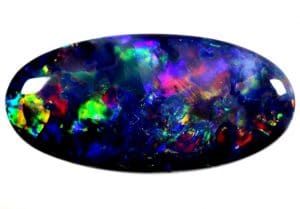
Opals are irresistable beautiful but at the same time quite delicate. Opals vary in optical density from opaque to semi-transparent and show a form of iridescence.
Black opals are the rarest, whereas white and greens are the most common.
Most noteworthy, opals are very sensitive to pressure and thermal shock (hot or cold), which causes crazing (surface cracking). Hence, this soft and fragile gem requires special care.
Opal is the birthstone for October and has a hardness of 5 1/2 – 6 1/2 on the Mohs scale.
“Pearls are always appropriate “
Jackie Kennedy
Perhaps the most beloved gem of all time. Pearls have been worn from the beginning of time and adorned by the noble, the rich and the famous as their favourite accessory item. They always look very elegant and can be worn with almost anything. Today everyone loves to wear pearls and here in Australia we are blessed with the best and highest quality available anywhere in the world.
The beauty of a pearl depends entirely on the quality of its nacre, 2.5-4.5 on the Mohs scale (extremely soft and prone to scratching)
While natural pearls are incredibly rare and found by chance, most pearls on the market today are cultured, meaning human intervention initiated the pearl-forming process.
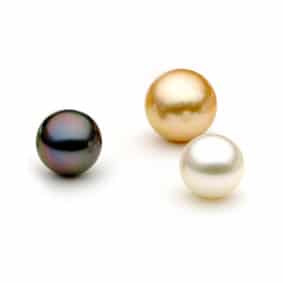
Japanese pearls, known for high luster and perfectly round shapes; typically, white or cream.
Australian pearls, prized for their thick nacre and satin-like gold or silver hues.
French Polynesia pearls, naturally “black” pearls, often showing peacock green, blue, or purple overtones.
Pearls produced in Rivers/Lakes, produced in higher volumes; come in a vast array of shapes (baroque) and pastel colours.
When evaluating pearls, gemologists typically look at seven specific criteria:
Size: Larger pearls are rarer and more expensive.
Shape: Perfectly round is the most valuable, though unique “baroque” shapes are popular in custom design.
Colour: Includes the body colour, overtone an orient.
Luster: Should be bright and sharp not dull.
Surface quality: Blemishes, pits and scratches reduce value.
Nacre Quality: Thick nacre ensures durability and a better glow.
Matching: For strands or earrings, how well the pearls look together in a set.
Pearl is the primary birthstone for June and the traditional gift for 3rd and 30th wedding anniversaries.
Always store pearls separately to your other jewellery items in a slightly moist linen cloth to prevent them from drying out in low humidity atmospheres.
Never expose your pearls to chlorinated water. Avoid contact with detergents, perfume, make up and perspiration. These will tarnish the lustre and will reduce the life of your pearls.
Remember to wipe your pearls down with a soft cloth after each wear.
Pearls should be worn on clean dry skin. Wear your pearls as much as possible as the oil of the skin improves their lustre. You should have them restrung once a year with new silk thread and best have them knotted to be on the safe side.
Follow these simple rules and your pearls will last a lifetime.
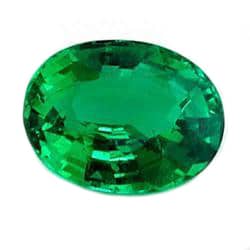
Emerald is the most famous member of the beryl family. While other beryls like aquamarine and morganite are valued for their clarity, emeralds are prized for their intense, lush green colour, which is caused by trace amounts of chromium, vanadium, and iron.
The “Jardin” (Garden) emeralds are rarely “eye-clean”. They typically contain a network of internal fractures and inclusions.
Despite their relatively high hardness, emeralds are quite brittle. Their internal fractures make them susceptible to damage from physical impact or pressure, which requires careful handling during setting and repair.
Emerald is the traditional birthstone for May, has a hardness of 7.5-8 on the Mohs scale and the gemstone for the 20th and 35th wedding anniversaries.
Emeralds require more specialized care than rubies or sapphires due to their inclusions and surface treatments. Avoid ultrasonic and steam cleaners, exposure to harsh chemicals, perfumes, use only a very soft brush and look warm mild soapy water.
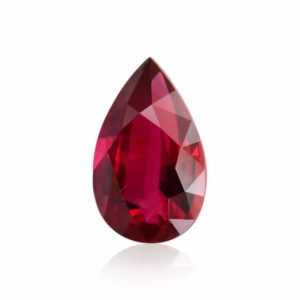
Ruby is the red variety of the mineral corundum, one of the most valuable and historically significant gemstones in the world. All other colours of gem-quality corundum are classified as sapphires.
The value of a ruby is primarily determined by its colour, followed by clarity, cut, and carat weight.
The “Pigeon’s Blood Red”, this is the trade term for the most sought-after ruby colour, a vibrant, medium dark red with a slight hint of blue. Historically, this hue is associated with the Mogok Valley in Myanmar.
Rubies often contain “silk” (slender needles of rutile). When these needles are dense and intersect, they can create a six-rayed star effect known as asterism, resulting in a “star ruby”.
Ruby is the traditional birthstone for July and is used to commemorate 15th and 40th wedding anniversaries.
Due to its exceptional hardness and lack of cleavage (a tendency to break along specific planes) ruby is an excellent choice for everyday jewellery, including engagement rings.
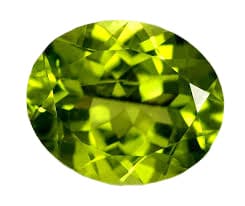
Peridot is a gem-quality variety of the mineral olivine. It is one of the few gemstones, that occurs in only one colour: olive-green; although the shades of green may vary from light yellowish to dark brownish-green.
Though it is known as the “Evening Emerald”, due to its high double refraction, peridot often appears to glow under artificial light, earning it this nickname in the ancient world. Peridot was mined as early as 1500BCE on Topazos island (now St. John’s Island ) in the Red Sea. Historians now believe that many of Cleopatra’s famous “emeralds” were actually peridots.
Historically, it was believed to protect the wearer from “terrors of the night” and nightmares when set in gold.
Peridot is the traditional birthstone for August and the gemstone used to celebrate 15th wedding anniversaries.
Peridot rates 6.5 to 7 on the Mohs hardness scale. It has fair to good toughness and is durable enough for jewellery wear but should be worn with some care so as not to scratch it or subject it to hard blows that can fracture it.
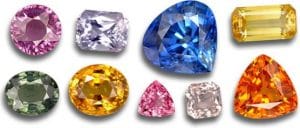
Sapphire is the most precious and valuable blue gemstone, a variety of the mineral corundum.
It is a very desirable gemstone due to its excellent colour, hardness, durability, and luster. The most desired colour is a pure cornflower-blue. They come in every colour of the rainbow. Except red. Sapphire has a hardness of 9 on the Mohs scale.
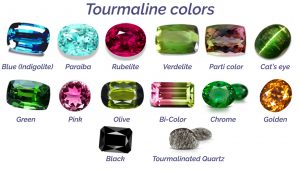
Tourmaline has a variety of exciting colours with one of the widest colour ranges of any gem species, occurring in various shades of virtually every hue. Scientifically, tourmaline is not a single mineral, but a group of minerals related in their physical and chemical properties. The most commonly encountered colours are the wide variety of pink and green Stones that are pale in colour or have secondary colours of brown or salmon are not considered with high.
Tourmaline has a hardness of 7-7.5 on the Mohs scale.

Amethyst is the purple variety of the mineral Quartz and its most valuable and prized variety. Its name derives from the Greek “amethystos”, which means “not drunken”, as Amethyst in antiquity was thought to ward off drunkenness.
Colour is the most important. Amethyst colours range from pale lilac to deep reddish purple and ranging from transparent to translucent quartz. The finest amethyst is a deep purple colour with minimal colour zoning and it looks the best in daylight.
Amethyst has a hardness of 7 on the Mohs scale.
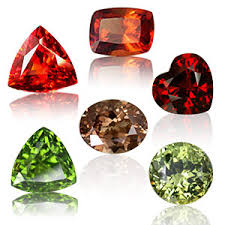
Garnets are a group of silicate minerals that have been used since the Bronze Age as gemstones and abrasives. All species of garnets possess similar physical properties and crystal forms but differ in chemical composition.
Garnets come in a variety of colors and have many different varieties. However, the most widely-known color of Garnet gemstones is dark red but green tsavorite & demantoid are the rarest and most valuable.
Garnets are hard, durable and brilliant and are valued on carat weight, colour, cut and clarity. Garnet has a hardness of 7– 7.5 on the Mohs scale.
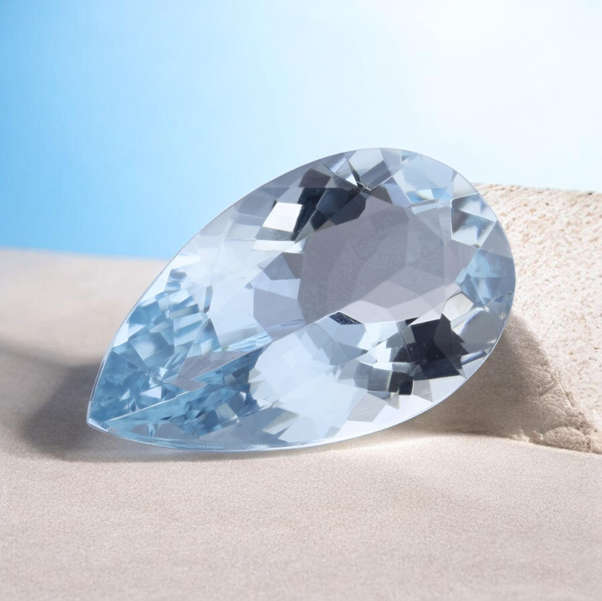
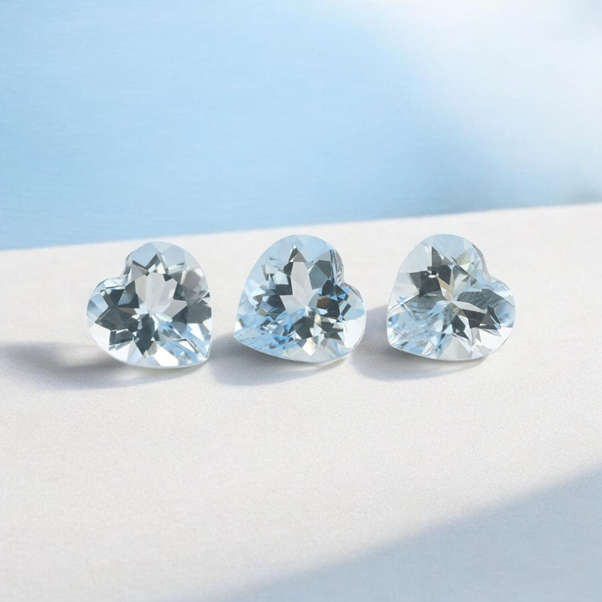
Aquamarine, the “Gem of the Sea” is a captivating light blue to teal- blue, transparent gemstone of the mineral beryl.
Historically, Aquamarine has been deeply tied to the ocean. “The sailors stone”, ancient Greeks and Romans carried it as a protective talisman to ensure safe passage across stormy seas and to prevent seasickness. Today, it is a symbol of tranquillity, serenity and clear communication.
Best for those who love high-clarity jewellery and a “cool” colour palette.
As the birthstone for March, it has hardness of 7.5-8 on the Mohs scale, making it suitable for everyday wear, including rings.
Aquamarine comes in a fantastic variety of sizes, commonly cut oval, round, emerald and pear shapes; often used in rings, pendants and earrings.
Though tough, Aquamarine can be damaged by harsh chemicals or extreme heat.
Avoid ultrasonic cleaners or steam cleaners, as they can cause stones with natural mineral inclusions to shatter. Store your aquamarine jewellery separate from harder gems like diamonds or sapphires, which can scratch the surface.
Use warm water, mild dish soap and a soft brush to clean your Aquamarine jewellery.
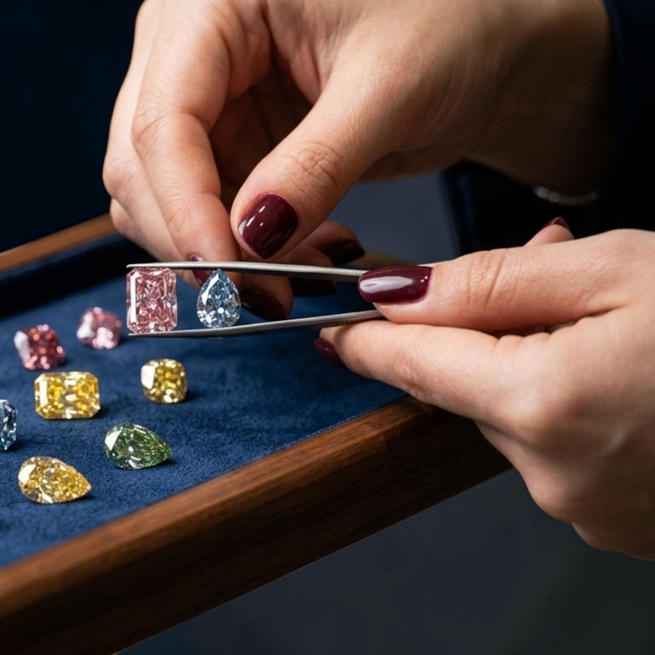
Diamonds have long been celebrated for their classic, colourless sparkle.
While colourless diamonds are iconic, the natural world holds an even rarer, more vibrant secret: Fancy Coloured Diamonds
Think warm, buttery yellows that radiate joy; delicate blush pinks for an elegant touch; and the deep, mysterious allure of teal or chocolate brown. These exceptional gems don’t just sparkle ; they tell a story in colour.
Champane diamonds are a sophisticated category of natural fancy – coloured diamonds characterized by their warm, golden-brown hues. They offer a unique, earthy alternative to traditional colourless stones and have become increasingly popular for bespoke and vintage – inspired designs.
They are often graded on a scale (frequently the C1-C7 Argyle scale) to describe their depth:
Pink diamonds are among the most mysterious and coveted gemstones in the world.
Until its closure in late 2020 , the Argyle Mine in Western Australia produced over 90% of the world’s pink diamonds . Since the mine closed , no new primary source has been discovered that matches Argyle’s volume or colour intensity . This has transformed pink diamonds from a luxury purchase into a high- value “legacy” asset.
While white diamonds are graded on a D-to-Z scale, pink diamonds use a specialized colour intensity scale. The deeper the colour , the more exponentially the value rises.
Yellow diamonds are some of the most vibrant and sought after fancy-coloured gems. Their “sunny” disposition makes them a favourite for those seeking an alternative to colourless diamonds that still offers a classic, timeless feel.
Yellow diamonds are unique because they exist on both the standard D-Z scale and the Fancy colour scale.
The “Cape “ Range : Diamond graded U through Z are technically colourless diamonds with a heavy yellow tint. They are often more affordable and look beautiful in yellow gold.
The “Fancy “ Range : Once a diamond’s colour is stronger than a “Z” masterstone, it enters the Fancy Colour scale: Fancy Light /Fancy/ Fancy Intense / Fancy Vivid / Fancy Deep
Grey diamonds – often referred to as “Silver” or “Cloud” diamonds – have become a breakout favourite for those who love a moody, sophisticated and alternative aesthetic. They sit perfectly between the classic brilliance of a white diamond and the edgy depth of a black diamond.
There are two types of grey diamonds:
Fancy Grey Diamonds: These are high clarity stones where the grey colour is uniform throughout the crystal.
Salt and Pepper Diamonds: These are diamonds with a high concentration of dark and white inclusions , giving them a speckled , “galaxy like “ grey appearance. These are incredibly popular for rustic or bohemian engagement rings.
Did you know that for every 10,000 colourless diamonds mined , only one will have enough natural colour to be called “Fancy”?